Address
304 North Cardinal St.
Dorchester Center, MA 02124
Work Hours
Monday to Friday: 7AM - 7PM
Weekend: 10AM - 5PM

Address
304 North Cardinal St.
Dorchester Center, MA 02124
Work Hours
Monday to Friday: 7AM - 7PM
Weekend: 10AM - 5PM


What is a 1–10 kVA high-frequency rack-mount UPS? What are its key advantages?
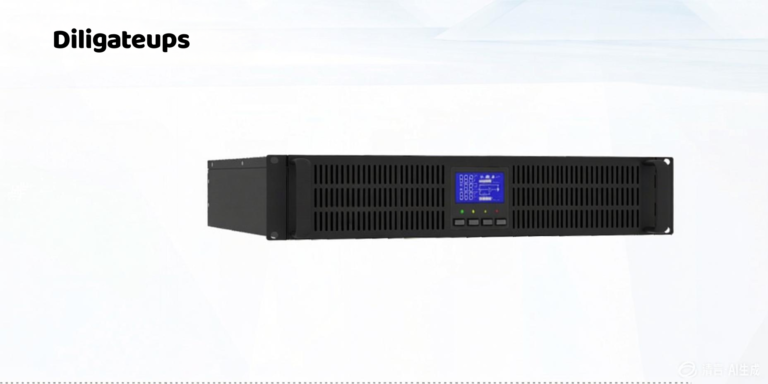
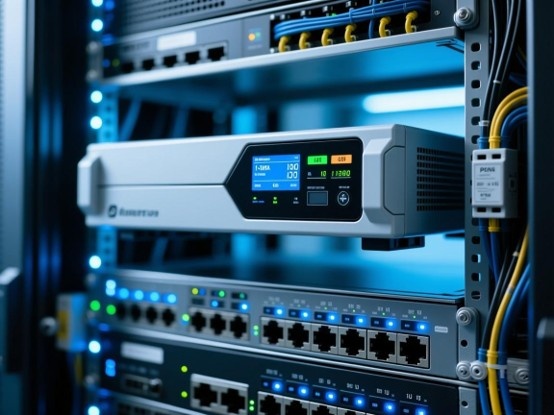
A: A 1–10 kVA high-frequency rack-mount UPS refers to a small- to medium-power uninterruptible power supply that uses an IGBT high-frequency switching topology, does not require a line-frequency isolation transformer, and can be installed directly into a standard 19-inch rack. Its key advantage lies in its “high power density”—compared to traditional line-frequency units, it is approximately 40% smaller and 50% lighter, with an overall efficiency of 95%–96% and an input power factor close to 1, making it ideal for small and medium-sized data centers and edge nodes with limited space.
What are the key differences in selecting a “single-phase three-wire” UPS under different national power grid standards?
A: “Single-phase three-wire” refers to L (live wire) + N (neutral wire) + PE (protective grounding).
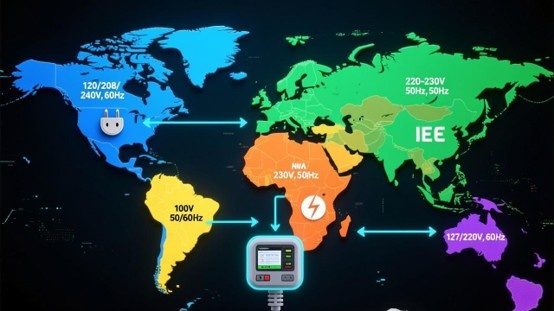
• Regions following the IEC standard (China, Europe, India, etc.): The standard is 220/230/240 V, 50 Hz. This is the “native market” for UPS systems, so you can simply select a single-phase input/output model.
• North American NEMA standard: Commercial buildings typically operate at 120/208V or 120/240V; high-power single-phase UPS units often require a 208V or 240V power supply.
• Special regions (e.g., Japan at 100V, Brazil at 127/220V): Models with a wide input voltage range and support for 50/60Hz dual-frequency adaptation must be selected.
Why is 10 kVA considered the “engineering threshold” for single-phase UPS systems?
A: In IEC regions operating at 230 V/50 Hz, the full-load current of a single-phase 10 kVA UPS is approximately 43 A. Taking into account a charging margin, a 63 A circuit breaker must be installed. This is close to the engineering and economic upper limit for single-phase power distribution. If the load continues to increase, maintaining a single-phase power supply would result in extremely thick cables, a sharp rise in circuit breaker costs, and potentially cause three-phase imbalance in the power grid. Therefore, once the load exceeds 10 kVA, it is generally recommended from an engineering perspective to transition to a three-phase input (or a 3:1 model).
What weaknesses should be considered when using high-frequency rack-mounted UPS systems in industrial applications?
A: Since high-frequency UPS systems do not include an output isolation transformer, their surge and impact resistance is weaker than that of line-frequency units. In industrial control applications (such as PLCs and DCS systems) or environments with poor power grid conditions, directly powering loads with high surge currents can easily damage the inverter. In engineering practice, it is often necessary to install surge suppressors or opt for an isolation transformer to enhance protection.