Address
304 North Cardinal St.
Dorchester Center, MA 02124
Work Hours
Monday to Friday: 7AM - 7PM
Weekend: 10AM - 5PM

Address
304 North Cardinal St.
Dorchester Center, MA 02124
Work Hours
Monday to Friday: 7AM - 7PM
Weekend: 10AM - 5PM

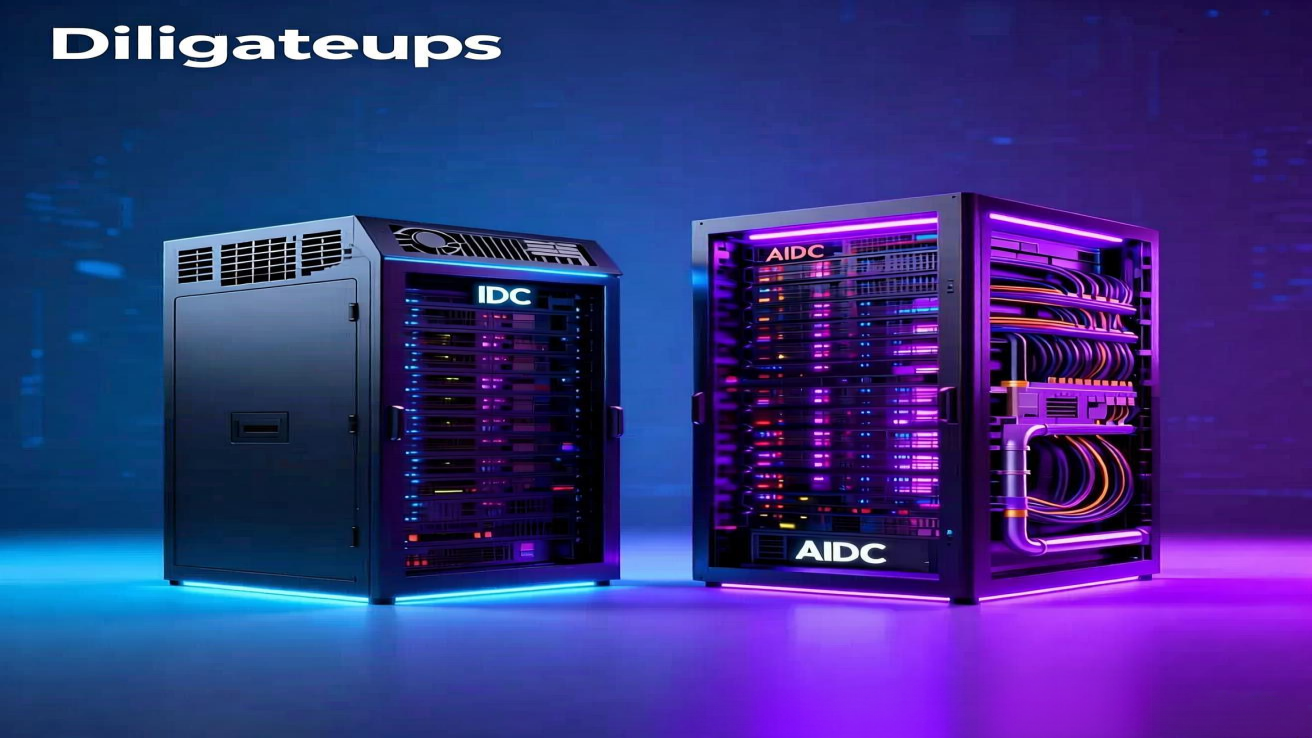
IDC vs AIDC difference: traditional IDC rack vs high-density AIDC rack
Here is the core difference: a traditional IDC hosts infrastructure, while an AIDC produces AI compute. The IDC serves CPUs and general IT workloads. In contrast, the AIDC packs GPU clusters at extreme density. Therefore, power, cooling, networking, and operations all differ fundamentally .
Many people still picture data centers as simple server rooms. However, AI compute demand is exploding. China’s intelligent computing capacity reached 1,037.3 EFLOPS in 2025. Moreover, it may hit 2,781.9 EFLOPS by 2028 — a 46% CAGR . As a result, data centers now split into two tracks: traditional IDC and AIDC.
Both look like server rooms. Yet their construction standards, hardware, and business models differ sharply. Consequently, buyers often confuse the two, mismatch standards, and waste budgets.
This article first shows a full comparison table. Next, it breaks down four dimensions: power density, cooling, networking, and operations. Finally, it ends with a selection guide.
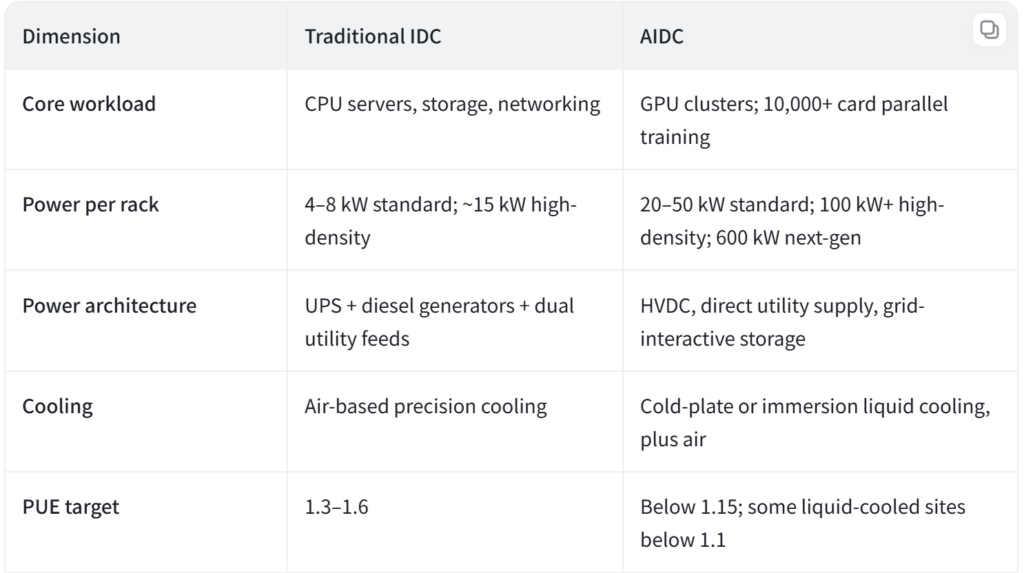
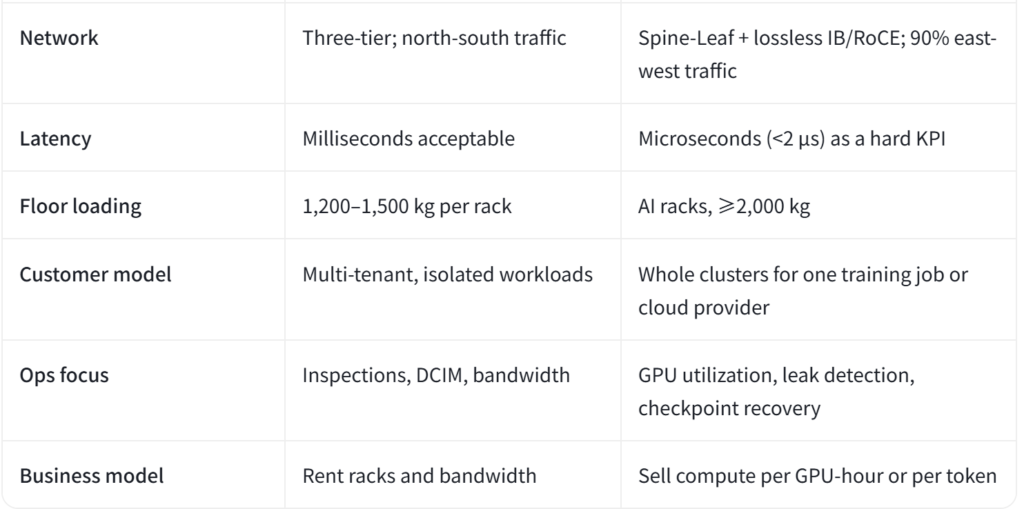
Data comes from CDCC reports, the Huawei AIDC white paper, and public sources.
Power density marks the sharpest difference. In fact, it drives every other infrastructure gap.
First, consider the traditional IDC. It hosts colocation, general cloud, and storage workloads. These loads stay stable. Therefore, racks draw only 4–8 kW, and legacy rooms run far below capacity .
Now compare the AIDC. It serves GPU clusters and large-model training. A single 8-GPU server alone draws 10–15 kW. Consequently, racks reach 25–50 kW, and high-density sites exceed 100 kW. Moreover, the curve keeps steepening. Global average rack power rose from 8.4 kW (2020) to 14.7 kW (2024). CDCC projects 19.4 kW by 2026, while next-gen NVIDIA Kyber racks plan about 600 kW .
Furthermore, AI loads spike hard. One training run can hold thousands of GPUs at full power for months. As a result, power systems face stress several times beyond IDC design limits. For example, a 100 MW AIDC consumes about 876 GWh yearly, and electricity eats over 60% of operating costs. Therefore, power design now shifts to HVDC and integrated energy architecture .
Traditional IDC cooling is a solved problem. Operators combine air conditioning, hot/cold aisle containment, and free cooling. This mix is cheap, simple, and delivers PUE of 1.3–1.6. For general workloads, it works well.
However, AI changes everything. High-density racks concentrate heat intensely. Air cooling hits a physical limit at roughly 20 kW per rack. Beyond that, GPUs throttle, performance destabilizes, and hardware wears faster .
Therefore, liquid cooling becomes standard in every AIDC. Three routes now dominate:
Today, liquid cooling covers about 80% of AI training loads, while air assists . Finally, note a hidden constraint: AI servers weigh 60–80 kg each. Ten of them approach a ton. Therefore, choose racks rated ≥2,000 kg — a bottleneck that often trips up legacy IDC sites .
3、Networking: From “Good Enough” to Lossless Compute Fabric
Traditional IDC networks use the classic three-tier design: core, aggregation, access. This design moves north-south traffic well. It costs little, runs mature, and tolerates minor jitter. In short, it is “good enough” for hosting and cloud workloads.
AI training, however, reverses the traffic model. In an AIDC, over 90% of traffic flows east-west between servers. GPUs constantly synchronize through collective communication. Consequently, the network must deliver ultra-low latency, zero packet loss, and massive throughput. Otherwise, thousands of GPUs stall together and burn money.
Therefore, every AIDC adopts the flat Spine-Leaf architecture. It removes hierarchy, pairs with InfiniBand or RoCEv2 lossless Ethernet, and pushes latency down to microseconds. This gap is the core technical wall between IDC and AIDC. Clearly, dropping GPU servers into an old room does not make it an AIDC.
Traditional IDC operations center on equipment assurance. Teams run inspections, fix faults, monitor environments, and manage bandwidth. The work is standardized, and the barriers stay low. Likewise, the business model is simple: rent racks, bandwidth, and power. Clients bring their own servers. Therefore, what runs inside the rack hardly matters to the operator.
AIDC operations, by contrast, maximize compute efficiency. Teams must manage GPU scheduling, liquid cooling, lossless networks, load balancing, and checkpoint recovery. Moreover, risk rises sharply. A traditional IDC outage annoys clients; an AIDC outage can interrupt thousands of GPUs and cost hundreds of thousands of dollars.
The business model changes most of all. An AIDC works like a factory: it consumes power and equipment, then produces compute. Success now depends on utilization, task completion, and unit compute cost — not just rack occupancy. Billing shifts to per-GPU-hour or per-token models. Liquid-cooled racks earn 30–50% rent premiums, and gross margins climb from ~25% to above 40% . As a result, operators must build engineering, platform, and operations skills together.
Misconception 1: An AIDC is just a renamed IDC.
In fact, an AIDC rebuilds power (HVDC), cooling (liquid), and networking (Spine-Leaf). Cramming GPUs into a legacy IDC risks failures in power, floor loading, and heat all at once.
Misconception 2: AIDCs will replace all data centers.
General IDC demand will persist for CDNs, edge computing, and cloud services. Therefore, the realistic future is dual-track: IDC hosts the base layer; AIDC powers the acceleration layer.
Misconception 3: Lower PUE and more liquid cooling are always better.
PUE is only one metric. Also weigh green power share, carbon, and water use. Moreover, immersion cooling raises TCO if your racks do not need it. Match the cooling type to rack density.
In short: a traditional IDC hosts infrastructure; an AIDC produces compute.
The difference goes beyond hardware. It rebuilds the entire logic of construction, operations, and standards. Therefore, telling IDC from AIDC is now essential knowledge for every engineer, operator, buyer, and consultant. More importantly, it is the first line of defense against mismatched standards and wasted budgets.