Address
304 North Cardinal St.
Dorchester Center, MA 02124
Work Hours
Monday to Friday: 7AM - 7PM
Weekend: 10AM - 5PM

Address
304 North Cardinal St.
Dorchester Center, MA 02124
Work Hours
Monday to Friday: 7AM - 7PM
Weekend: 10AM - 5PM


Principles of Cold Plate Liquid Cooling Systems
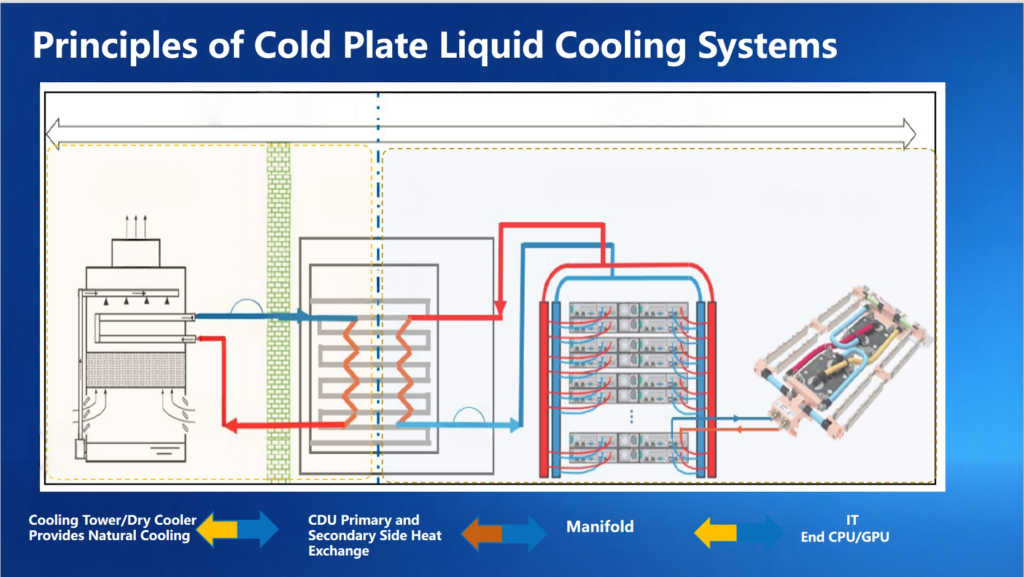
Cold Plate Liquid Cooling Systems is primarily used for cooling servers in data centers.
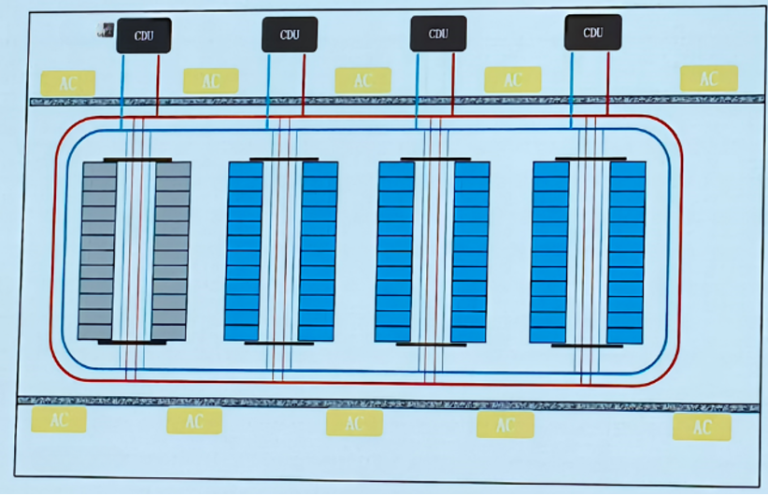
The entire system is divided into primary and secondary sides: the primary side utilizes outdoor air as a natural cooling source via dry coolers or closed-circuit cooling towers, equipped with fans and spray pumps to facilitate air-to-water heat exchange; the secondary side performs heat exchange between the primary and secondary sides through heat exchange units within the Cooling Distribution Unit (CDU), then distributes the cooled water to individual racks via the piping distribution unit, ultimately directly cooling heat-generating components such as CPUs and GPUs in IT equipment.
The system’s operational workflow is as follows: the cooling tower provides a natural cooling source → the CDU performs heat exchange → the manifold distributes and collects water → IT endpoints are cooled. It features highly efficient heat dissipation, energy efficiency, environmental friendliness, and precise temperature control. It is particularly suitable for high-density data centers and AI computing clusters, effectively addressing the insufficient cooling capacity of traditional air-cooling systems.
High-Temperature Water-to-Water Heat Exchanger CDU
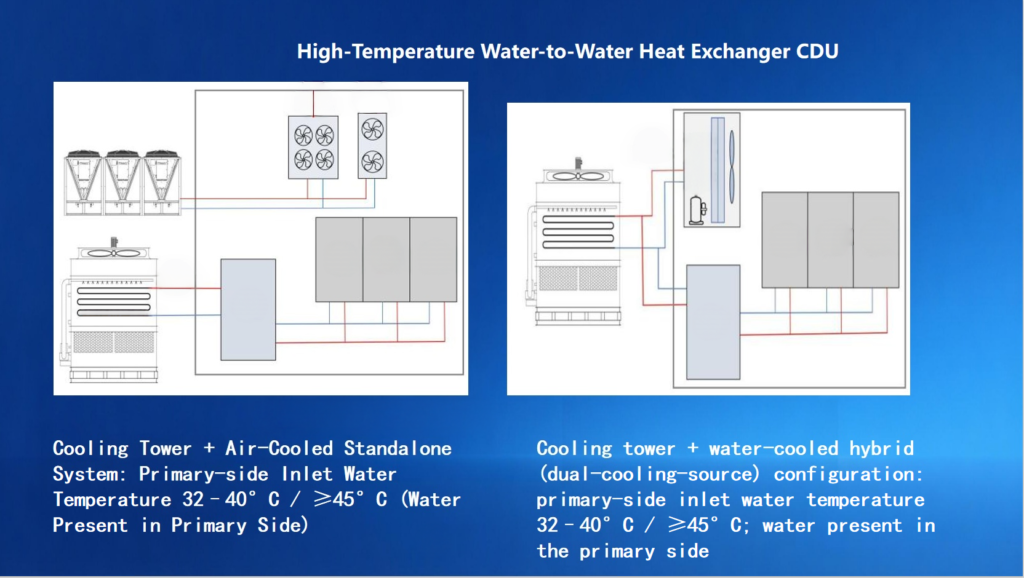
High-Temperature Water – Water Heat Exchange CDU Technology utilizes a cooling water circulation system to facilitate heat exchange between the primary and secondary sides via the CDU, efficiently removing heat from IT equipment. It is suitable for high-temperature operating conditions with primary-side inlet water temperatures of 32–40°C or ≥45°C.
Low-Temperature Water-to-Water Heat Exchanger CDU
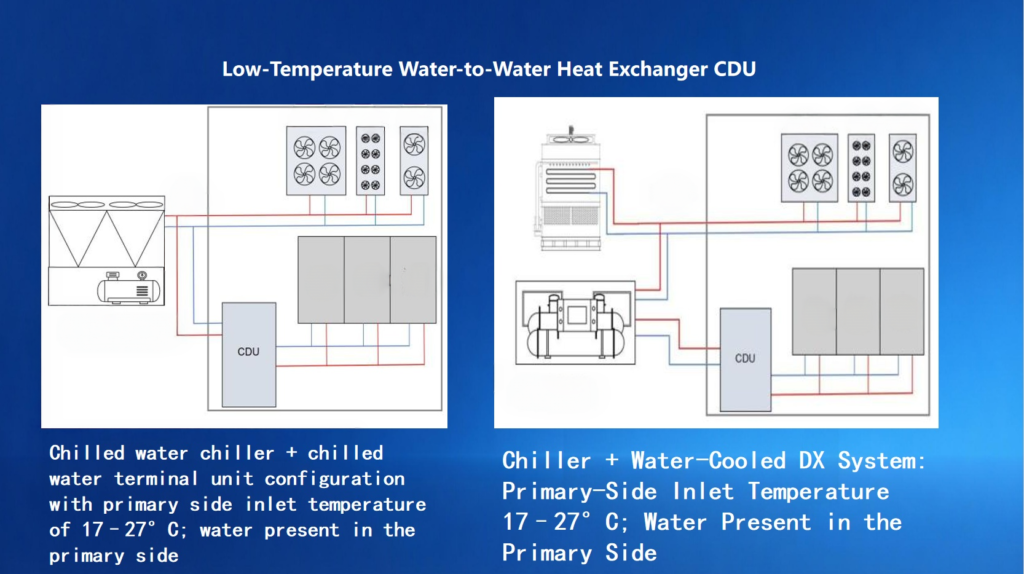
Low-Temperature Water – The water-based heat exchange CDU system uses low-temperature water (primary side inlet temperature: 17–27°C) as the cooling source. It prepares cooling water through two configurations—the “chiller (with natural cooling) + architecture” on the left and the “chiller + water-cooled DX architecture” on the right—and transfers the heat generated by IT equipment (such as CPUs and GPUs) to the cooling water via heat exchange between the CDU (cooling distribution unit) and liquid-cooled cabinets; The heat is then dissipated through the cooling water circulation loop. This process is complemented by auxiliary cooling equipment—such as air walls, backplates, and inter-row fans—to ensure efficient cooling of high-density IT equipment and achieve low-temperature heat exchange and thermal management within the data center’s liquid cooling system.
Fluorine-Water Heat Exchange CDU
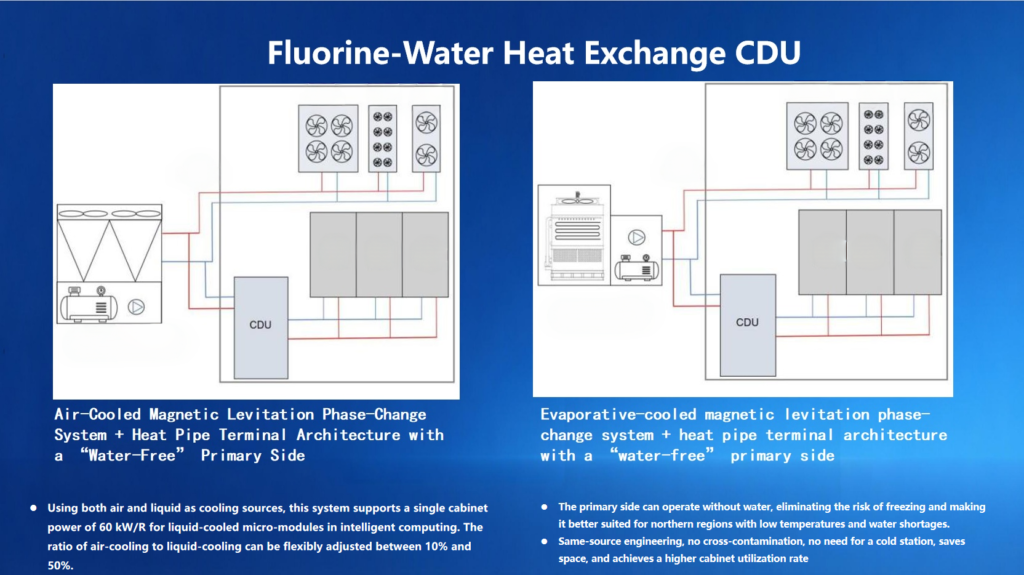
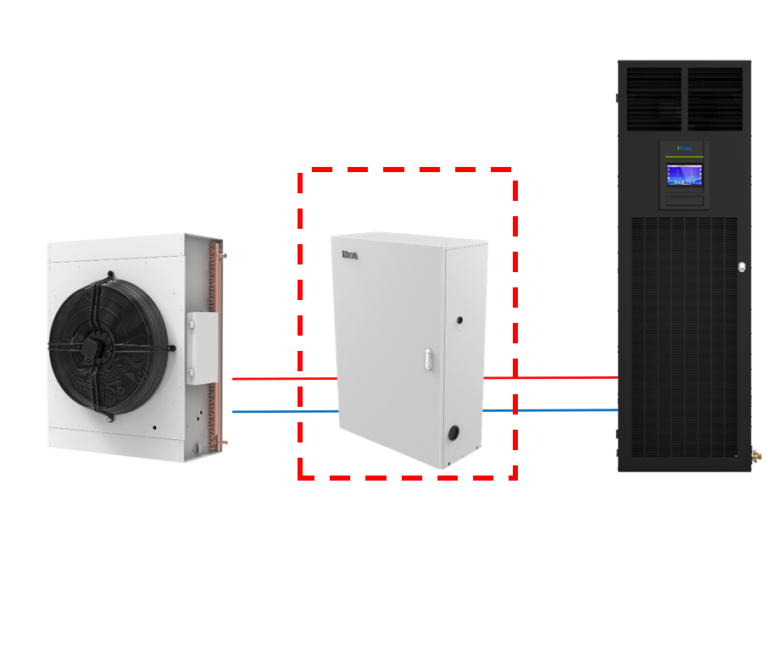
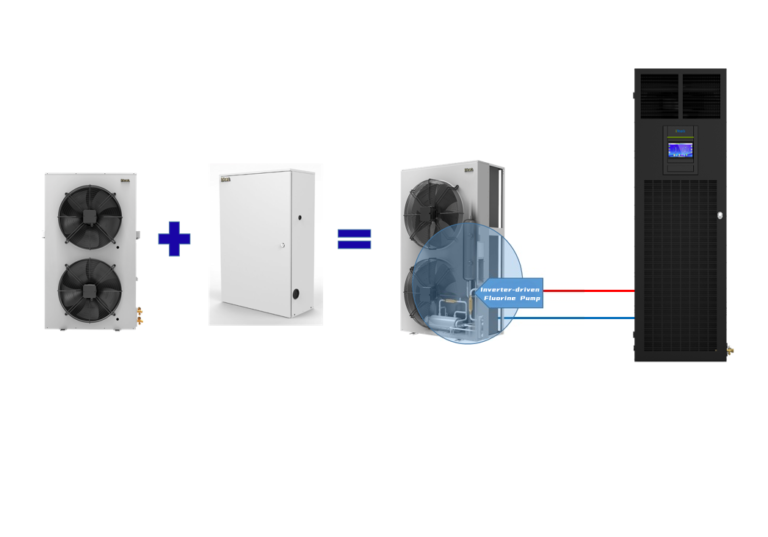
The Fluorine-Water Heat Exchange CDU uses fluorine (refrigerant) to replace traditional water systems as the primary-side coolant. Combined with magnetic levitation phase-change technology, it efficiently generates cooling capacity. After heat exchange within the CDU, it provides cooling for liquid-cooled cabinets, supplemented by terminal heat dissipation equipment, to achieve efficient and reliable cooling of IT equipment.