Address
304 North Cardinal St.
Dorchester Center, MA 02124
Work Hours
Monday to Friday: 7AM - 7PM
Weekend: 10AM - 5PM

Address
304 North Cardinal St.
Dorchester Center, MA 02124
Work Hours
Monday to Friday: 7AM - 7PM
Weekend: 10AM - 5PM


Vietnam Data Center Power Market Size and Share
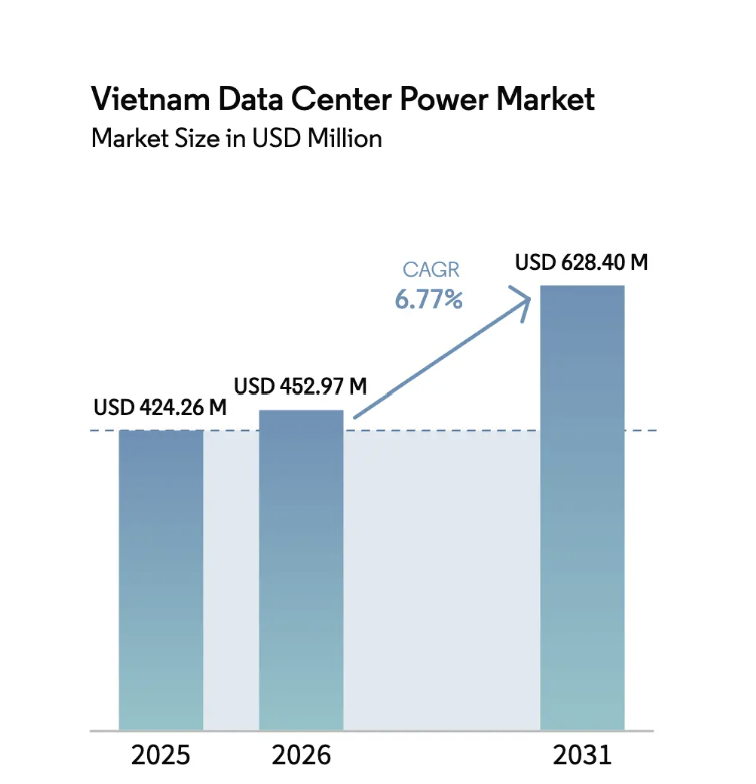
Source: Vietnam Data Center Power Market Size & Share Analysis & Industry Research Report 2031
The Vietnam data center power market size was valued at USD 424.26 million in 2025 and estimated to grow from USD 452.97 million in 2026 to reach USD 628.4 million by 2031, at a CAGR of 6.77% during the forecast period (2026-2031).
This pace underscores Vietnam’s evolution into a preferred digital hub within Southeast Asia as operators pivot away from higher-cost regional locations. Foreign-ownership liberalization, expanding cloud and AI workloads, and national energy plans that double generation capacity to 155 GW by 2030 are converging to lift demand for resilient and efficient power infrastructure. Accelerated rack densities that now reach 40 kW and above per cabinet are reshaping power distribution architectures, while utility price reforms encourage upgrades to high-efficiency UPS and intelligent PDUs.
Why has the Vietnamese data center market suddenly become so popular?
1.Government program encourages private sector to invest in digital infrastructure
Deputy Prime Minister Nguyen Chi Dung on September 29 in 2025 signed a decision approving a program to encourage private enterprises to take part in developing telecommunications and other infrastructure for national digital transformation through 2030.
Under Decision 2161/QD-TTg dated September 29, the program focuses on new types of digital infrastructure with high growth potential, including data centers, cloud computing, physical–digital infrastructure, digital utilities, and digital technologies such as services and high-quality broadband connectivity. It aims to harness the strengths of the private sector, mobilize all social resources, and use them effectively for developing digital infrastructure.

Source: https://english.luatvietnam.vn/legal-updates/government-program-encourages-private-sector-to-invest-in-digital-infrastructure-892-104446-article.html
2. Amendments to the “Telecommunications Law” Allow Wholly Foreign-Owned Data Centers
Doanh nghiệp cung cấp dịch vụ trung tâm dữ liệu, dịch vụ điện toán đám mây có các quyền sau đây:
a) Đầu tư kinh doanh dịch vụ trung tâm dữ liệu, dịch vụ điện toán đám mây không giới hạn tỷ lệ sở hữu cổ phần, phần vốn góp hoặc tỷ lệ đóng góp của nhà đầu tư nước ngoài trong hợp đồng hợp tác kinh doanh
This marks the official transition of Vietnam’s data center market from a “state-dominated, closed market” to a “private-sector-dominated, open market.” The government has not only lifted market access restrictions but has also elevated data centers to the strategic level of “national infrastructure,” meaning that data center projects will receive unprecedented priority in terms of key resources such as land and electricity in the future.
Source: https://luatvietnam.vn/thong-tin/luat-vien-thong-2023-so-24-2023-qh15-284795-d1.html
3.Boom in the Digital Economy
Vietnam digital economy’s contribution to GDP is estimated to reach 18.3% in 2024, with a growth rate exceeding 20% per year, three times higher than the GDP growth rate, and the fastest in Southeast Asia, according to a report presented at a meeting chaired by Prime Minister Pham Minh Chinh on February 6.
Source: https://vietnamnet.vn/en/vietnam-s-digital-economy-expands-at-record-pace-now-18-3-of-gdp-2369146.html
4. Data Compliance and Localization Pressures
At the level of personal data, Vietnam’s “Decree on Personal Data Protection” (Decree 13/2023/ND-CP) establishes strict procedural requirements for the cross-border transfer of Vietnamese citizens’ personal data, including the need to conduct a cross-border transfer impact assessment and report to the competent authorities in certain circumstances. This effectively increases the compliance costs associated with storing and processing Vietnamese users’ data overseas.
At the broader level of “data sovereignty,” Vietnam’s Law on Data further introduces classifications such as “critical data” and “core data,” imposing additional restrictions on the cross-border transfer and storage of such data based on national security considerations, thereby providing a higher-level legal basis for the local storage of critical data.
The combination of these two factors has led large internet platforms and industries such as finance and telecommunications to increasingly favor building local data centers within Vietnam when planning their data center deployments, in order to meet compliance requirements and mitigate the risks associated with cross-border data transfers.
Source: https://xaydungchinhsach.chinhphu.vn/toan-van-nghi-dinh-13-2023-nd-cp-bao-ve-du-lieu-ca-nhan-119 230516104357809.htm
5. Data Center Infrastructure Supply Gap