Address
304 North Cardinal St.
Dorchester Center, MA 02124
Work Hours
Monday to Friday: 7AM - 7PM
Weekend: 10AM - 5PM

Address
304 North Cardinal St.
Dorchester Center, MA 02124
Work Hours
Monday to Friday: 7AM - 7PM
Weekend: 10AM - 5PM

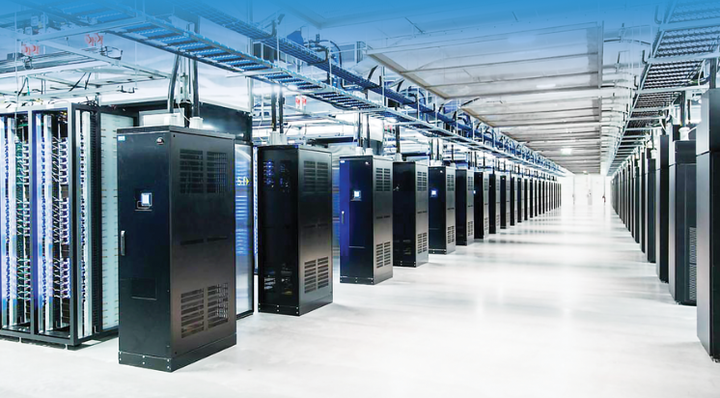
Technical Approach: Mainstream UPS Topologies and Power Ranges in Vietnam
1. Topology: Double-conversion (online) is predominant, with a clear trend toward modular designs
The UPS market for data centers in Vietnam is categorized by topology into Standby, Line Interactive, Double Conversion, and others. Among these, large data centers typically opt for Double Conversion (online) to ensure complete isolation from grid fluctuations and power outages.
Typical Configurations:
Large Data Centers:
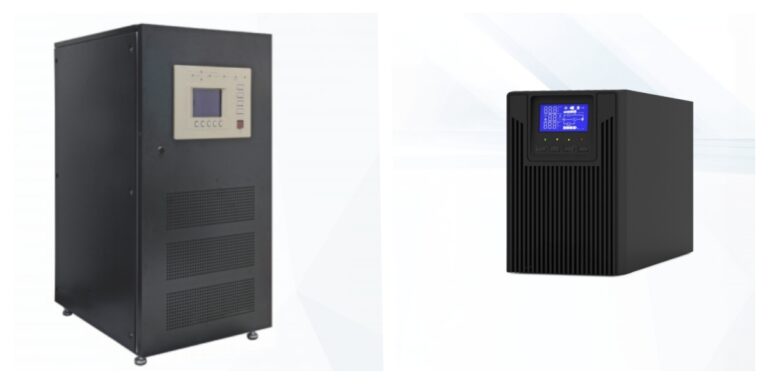
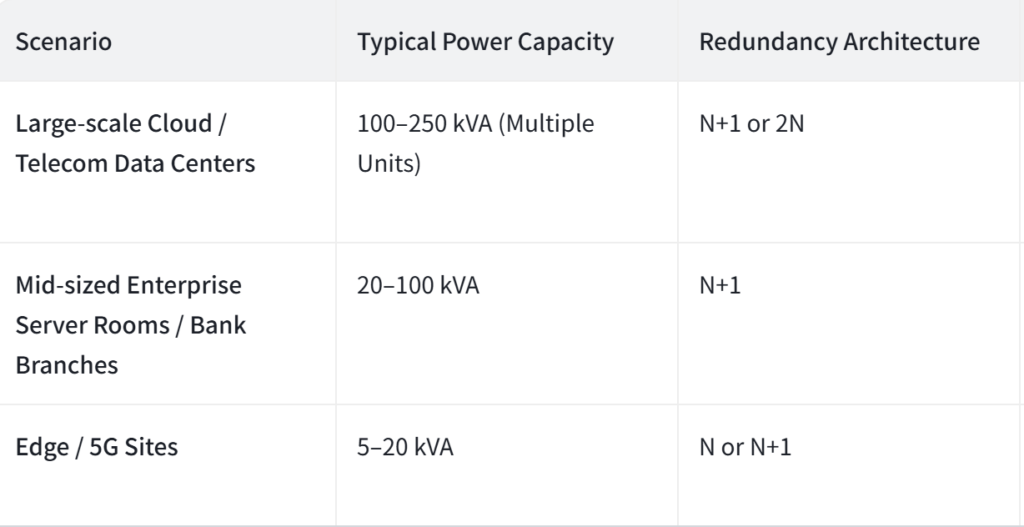
Double-conversion online UPS + N+1 or 2N redundancy, with common capacity ranges of 100–250 kVA, and multiple units connected in parallel.
Modular UPS systems are preferred (e.g., 20 kVA per module, scalable up to hundreds of kVA) to facilitate future expansion and maintenance.
Small and Medium-Sized Data Centers/Edge Sites:
20–100 kVA online or modular UPS systems, paired with rack-mounted PDUs and monitoring systems.
2. Power Range: 101–250 kVA Modular Systems Are the Most Popular
According to a report on UPS systems in Vietnamese data centers, Southeast Vietnam (around Ho Chi Minh City) and Northern Vietnam (around Hanoi) are the regions with the highest concentration of demand, collectively accounting for approximately 80% of the market share.
These areas are home to cloud data centers, telecommunications hubs, and large enterprise server rooms; as a result, modular UPS systems in the 101–250 kVA range are considered “popular specifications” in Vietnam.
A typical example is the 250 kVA HSTP3T250KE UPS deployed by Viettel IDC, which falls precisely within this power range.
Summary:
Topology: Large data centers primarily use double-conversion online UPS systems; small and medium-sized server rooms are gradually adopting modular UPS systems.
Power Range: 101–250 kVA is the most common range and is particularly well-suited for modular UPS systems.
Battery Technology: Lead-Acid Dominates, Lithium-Ion Is a “Bonus”
Current Mainstream: VRLA Lead-Acid
A report on Vietnam’s data center UPS market notes:
The market is transitioning from traditional VRLA lead-acid batteries to lithium-ion battery UPS systems, but lead-acid remains the mainstream option at present.
The advantages of lithium-ion UPS systems lie in higher energy density, longer service life, and lower maintenance requirements, though they entail higher upfront investment.
Most actual projects (such as the 250kVA UPS at Viettel IDC) currently still employ a solution consisting of lead-acid batteries paired with a battery management system.
System Architecture: The Most Popular UPS “System Solutions” for Data Centers in Vietnam
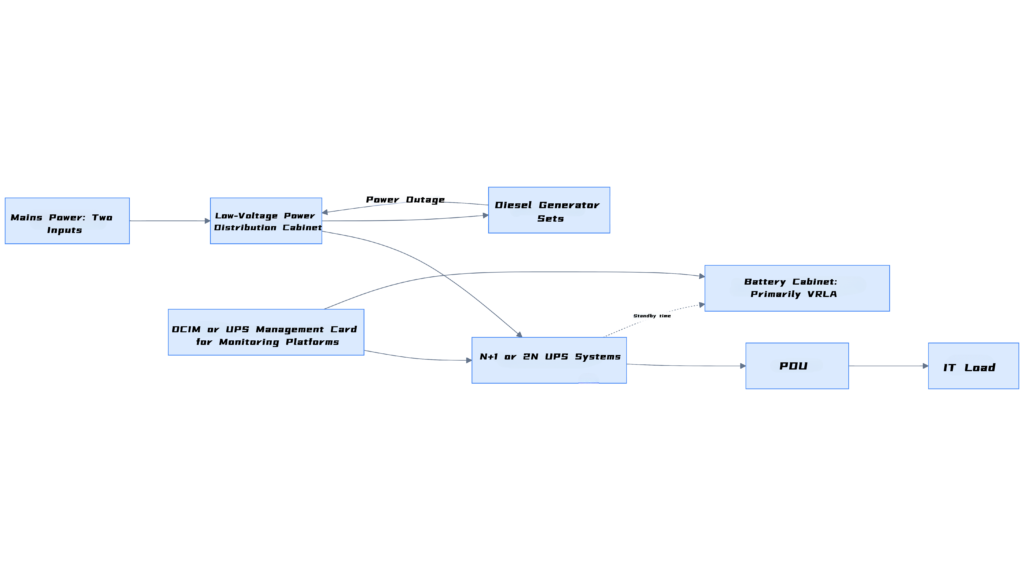
Typical Parameters:
Redundancy:
Large cloud data centers: 2N or N+1 UPS systems, combined with dual-path utility power and diesel generators.
Small and medium-sized enterprise server rooms: N+1 UPS.
Backup Time:
Typically designed for 10–15 minutes of backup time, which is sufficient for the diesel generator to start up and take over the load.
Diesel Generator Coordination:
Due to voltage fluctuations and occasional power outages in Vietnam’s power grid, the UPS primarily addresses “short-duration sags” and the gap between a power interruption and the start-up of the diesel generator.
Monitoring:
A report on the Vietnamese UPS market indicates that remote monitoring, predictive maintenance, and smart UPS systems are becoming trends.
In actual projects, SNMP/Modbus network management cards and environmental sensors are typically installed and integrated with DCIM or operations and maintenance platforms.
Comparison of the “Most Popular” Solutions in Different Scenarios
How to Select a More “Practical” UPS Solution in Vietnam?
If you’re designing solutions or selecting products for the Vietnamese market, consider the following approach:
Prioritize mainstream brands
Choose from Schneider, Vertiv, Eaton, ABB, Siemens, Delta, or CyberPower, as they offer better after-sales service and local support.
Topology and Power Ranges
Large data centers: Directly select three-phase online modular UPS systems in the 101–250 kVA range.
Small and medium-sized server rooms: 20–100 kVA modular or rack-mounted online UPS systems.
Batteries and Backup Time
General projects: VRLA batteries with 10–15 minutes of backup time.
For projects with high space and lifespan requirements: Consider lithium-ion UPS systems, but evaluate the supply chain and costs.
Integration with Diesel Generators
Given the limited stability of Vietnam’s power grid, UPS systems must integrate “seamlessly” with diesel generators; standardized interfaces and automatic transfer logic are recommended.
Monitoring and Operations & Maintenance
Equip systems with at least a remote monitoring card and environmental monitoring; if possible, integrate with DCIM to enable predictive maintenance.