Address
304 North Cardinal St.
Dorchester Center, MA 02124
Work Hours
Monday to Friday: 7AM - 7PM
Weekend: 10AM - 5PM

Address
304 North Cardinal St.
Dorchester Center, MA 02124
Work Hours
Monday to Friday: 7AM - 7PM
Weekend: 10AM - 5PM


Vietnam, the country with the fastest-growing digital economy in Southeast Asia, has seen its data center industry transform from a “marginal appendage” to “core infrastructure” over the past 20 years. From the early “computer rooms” tucked away in corners of telecommunications buildings to today’s planned hyperscale AI computing hubs, the history of Vietnam’s data center development is a story interwoven with policy drivers, technological iterations, and market explosions. This article traces the key milestones to help you understand this “evolutionary chain.”
一、Early-Stage Technology Parks and Software Park Data Centers
In 2000, Vietnam’s first large-scale software park—Quang Trung Software City (QTSC)—was launched in Ho Chi Minh City, marking the transition of Vietnam’s IT industry from a fragmented state to a cluster-based model. At that time, data centers were primarily “supporting facilities” for software parks, consisting mainly of small server rooms designed to meet internal server hosting needs.
In 2000, the Vietnamese Government implemented the National Program for Promoting Application and Development of Information Technology for Industrialisation and Modernisation.
As part of implementing the Government’s policy on the formation and development of the software industry, the Ho Chi Minh City People’s Committee decided to build Quang Trung Software City (QTSC) in October 2000. In order to manage and operate QTSC, this Committee also formed a professional organisation for IT park management, namely QTSC Development Company, a state-owned enterprise. QTSC Development Company launched its business in March 2001. Since 2001, QTSC has been regarded as the preferred investment destination for IT investors. Investments, focusing on software and IT services fields were developing rapidly in the area. By 2015, it was projected that this area would be fully filled. In 2012, the City Council planned to expand QTSC for enhancing the economic sector and pursuing the 2010 National Strategy in Transforming Vietnam into an advanced ICT country by 2020.
source: https://www.researchgate.net/publication/281190499_Quang_Trung_Software_City_-_The_Largest_Vietnamese_Software_Park
In 2008, Viettel IDC was established, becoming Vietnam’s first data center service provider to operate in accordance with “international standards.” Although its scale was limited, it laid the groundwork for subsequent industry standardization. At this stage, data centers had not yet emerged as an independent “industry” but were largely affiliated with telecommunications companies or software parks; technical standards were vague, and energy consumption was generally high (with PUE typically above 2.5).
Over its 16-year history, Viettel IDC has achieved numerous milestones, including becoming Vietnam’s largest data center service company and first cloud service provider. Today, it offers the most comprehensive cloud service ecosystem in the country, serving major Vietnamese enterprises and global digital content companies.
source: https://baxtel.com/data-centers/viettel-idc
二、Beginnings and Standardization (2010–2017): From “Server Rooms” to “Tier III IDCs”
After 2010, Vietnam’s data centers began transitioning toward “standardization.” In 2015, FPT Telecom completed Vietnam’s first data center certified by the Uptime Institute as Tier III, marking the upgrade of Vietnam’s IDCs from “extensive server rooms” to “high-availability infrastructure.” During the same period, operators such as VNPT and FPT gradually spun off their data center businesses and launched commercial colocation services, with technical standards (such as rack density and power redundancy) beginning to align with international benchmarks.
FPT Data Center Tier III was completed and launched in 2009.
FPT Data Center is the first data center in Vietnam to achieve the US-based Uptime Institute’s TIER III STANDARD.
source: https://fpt.vn/en/business/services/fpt-data-center.html
三、Regulatory-Driven Phase (2018–2022): “Data Localization” Sparks Explosive Demand
In 2018, Vietnam’s Cybersecurity Law officially took effect, mandating that “foreign companies collecting data from Vietnamese users must store that data within Vietnam.” This policy served as a “catalyst” for the industry’s explosive growth: banks, e-commerce platforms, and streaming services (such as Zalo and MoMo) were forced to “relocate” their data to comply with regulations, generating significant demand for data center construction.
During the same period, the Vietnamese government issued the “National Digital Transformation Plan (Decision 749/QĐ-TTg),” which explicitly designated “databases, cloud platforms, and high-performance computing centers” as core components of digital infrastructure, thereby elevating data centers from “commercial facilities” to “national strategic assets” at the policy level.
The Vietnam Cybersecurity Law (Law No. 24/2018/QH14) represents a pivotal moment in Southeast Asian digital governance, establishing comprehensive data sovereignty regulations that fundamentally reshape data management practices. Enacted by the National Assembly in November 2018 and fully implemented through 2019-2020, the law emerged from Vietnam’s strategic objectives to enhance national security and maintain strict control over citizen data.
source: https://dcatlas.io/en/standards/VN-CYBERSECURITY-LAW
In August 2022, the Government of Vietnam promulgated Decree No. 53/2022/ND-CP, elaborating a number of articles of the Law on Cybersecurity of Vietnam. Decree 53 is expected to make the Cybersecurity Law, which was issued in June 2018, more enforceable in practice. Decree 53 takes effect on October 1, 2022.
In particular, Decree 53 subjects foreign and domestic enterprises that provide services on telecommunications networks, the Internet, and the value-added service (VAS) in cyberspace in Vietnam to data retention requirements.
source: https://www.trade.gov/market-intelligence/vietnam-cybersecurity-data-localization-requirements
What’s in the new regulations?
The measures were unveiled within Decree 53/2022/ND-CP (Decree 53) can be summarized in the three following areas:
Owners of information deemed important are required to, among others, (a) provide certain prescribed information to the relevant government authorities, and (b) comply with prescribed security measures.
The degree provides authorities with the power to require companies to take certain measures – such as deleting data, providing authorities with data, and suspension of domain names – when the law has been violated, or if there is an infringement of national security, social order, and safety.
Domestic companies, and certain foreign companies providing specified services (e.g., telecommunications, e-commerce, online payment), will have to store specific types of data in Vietnam for a minimum period of 24 months. System logs relating to violations of the law must be stored for at least 12 months. Foreign companies impacted by the regulatory changes are also required to set up a branch or representative office in Vietnam.
source: https://www.vietnam-briefing.com/news/how-are-foreign-investors-responding-to-vietnams-new-data-localization-regulation.html
四、The Boom and Hyperscale Phase (2023–Present): Foreign Investment and the AI Computing Power Race
Starting in 2023, Vietnam’s data center sector entered a “hyperscale expansion phase.” According to a 2024 report by the Vietnam Internet Association (VNCDC), Vietnam’s data center capacity is projected to jump from 45 MW in 2024 to 525 MW in 2025 and approach 1,000 MW by 2030.
source: Vietnam’s Data Center Capacity Nears 1000MW by 2030 – VnEconomy
Local Giants Step Up: Viettel plans to build 24 data centers by 2030, with a combined capacity of 560 MW; among them, the Tan Phu Trung project in Ho Chi Minh City (140 MW, 10,000 racks) has become a landmark project. FPT is partnering with South Korea’s GS E&C to develop “AI-ready” data centers, emphasizing scalability and advanced cooling technologies.
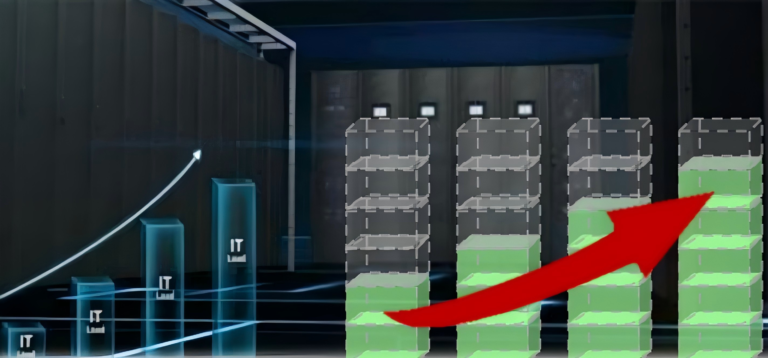
Foreign Investment Accelerates: Japan’s NTT has established a data center in the Saigon Hi-Tech Park in Ho Chi Minh City, providing 6 MW of IT load, setting a benchmark for international players entering the market.
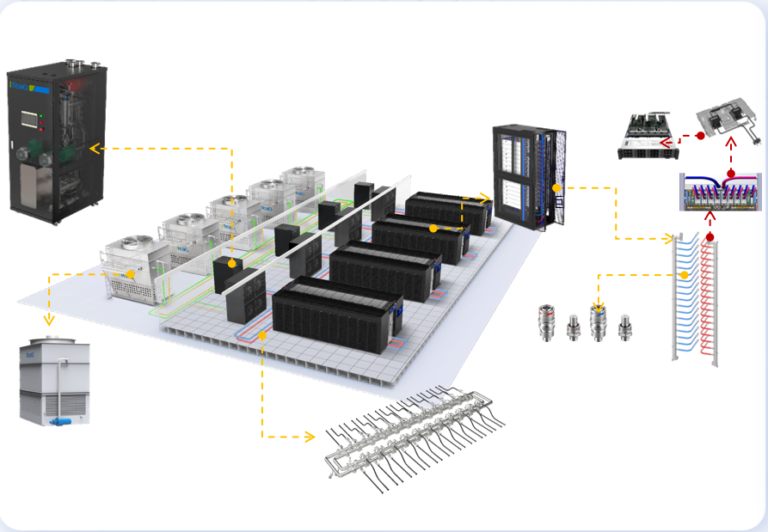
Cloud and Supercomputing Demand: International cloud providers such as AWS and Google Cloud are capturing market share through local partners, while demand for AI computing power (such as the deployment of NVIDIA H100) is driving data centers toward high-density and liquid-cooled configurations.
五、Outlook for the Future: National Data Centers and the New “AI + Liquid Cooling” Frontier
In 2025, Vietnam’s National Data Center was completed, becoming the first national-level data center to obtain top-tier international certification. This marked Vietnam’s transition from “disparate server rooms” to a “unified digital foundation.” During the same period, the *National Data Strategy (2026–2030)* designated data as a “strategic resource,” emphasizing the development of a national database, shared computing power platforms, and AI infrastructure to further drive the evolution of data centers toward an integrated “data + computing power + AI” model.
Faced with dual pressures from climate and technology, cooling systems have become critical: Vietnam’s data center cooling market is projected to grow from approximately $26.36 million in 2025 to about $54.78 million by 2031. Although the penetration rate of technologies such as immersion liquid cooling remains low in Vietnam, they have already entered the “market research phase,” and the demand for AI computing power is accelerating their commercialization.
From “makeshift server rooms” to the “heart of AI computing power,” Vietnam’s data centers have covered the ground that developed countries took 30 years to traverse in less than 20 years. In the future, as policy benefits take effect and AI demand surges, Vietnam is poised to become Southeast Asia’s new “digital infrastructure hub.”
By 2030, 90% of cultural heritages, national relics, and special national relics in Việt Nam will go digital by forming digital libraries and digital heritages.
source: https://english.mst.gov.vn/vietnams-national-data-strategy-towards-2030-approved-197240216084650104.htm
To ensure data sovereignty, the Strategy aims to put into operation the National Data Security Monitoring System operating 24/7; over 90% of information systems containing core data fully meet protection standards; 100% of national databases and critical data systems are controlled over the entire data lifecycle, and provide tools for people and organizations to directly monitor the use of their data.
With a vision to 2045, Vietnam aims to achieve 100% of the leadership, direction, governance and administration activities of Party and State agencies supported by data; At least 90% of important decisions and policies are built on the basis of data analysis and artificial intelligence. At the same time, Vietnam strives to master at least 80% of its core data platforms, technologies and products, belonging to the group of 30 countries leading the world in terms of governance, data mining and AI development capacity, becoming an important center in the region for storage, processing, connecting and transiting data across borders.
source: https://antoanthongtin.vn/tin/phe-duyet-chien-luoc-du-lieu-quoc-gia-dua-du-lieu-thanh-tai-nguyen-chien-luoc-va-dong-luc-phat-trien